AI and search
Google in 2026: what’s changing (AI, ads and agentic commerce) and how to adapt without losing leads

By Raúl Solana, founder of ConfiGrowth
Published Updated 5 min read
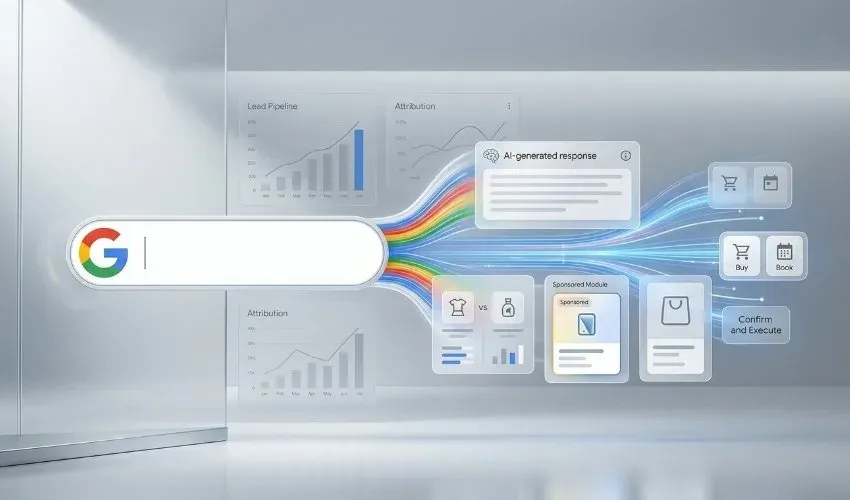
In 2026, Google isn’t just improving search. It’s pushing a change in behavior: from searching and clicking to asking and executing (buying, comparing, booking, handling paperwork) inside AI-guided experiences.
And here’s what matters for your business: the way Google “recognizes” you is changing too. Ranking in the top 10 is no longer enough: it’s increasingly common for Google to cite sources outside the top 10, to blend more sources into a single answer, and for citations to get fewer direct clicks (because users get what they need sooner).
At ConfiGrowth we boil it down to one sentence: less obsession with visits, more obsession with measurable influence on pipeline.
What Google is preparing for 2026
Google is doubling down on AI at an “infrastructure” level: its parent company (Alphabet) has said it could raise capital spending to $175-185 billion in 2026, largely for AI and cloud.
Why should you care if you run a brand or business in Spain? Because when a company puts in that level of investment, it isn’t for an experiment: it’s to change its core product (search + ads + commerce) and monetize it.
More AI across every search surface
The direction is clear: AI is becoming a cross-cutting layer (answers, recommendations, comparison tools, assistants). And it affects your visibility in two very specific ways:
- More “distributed” citations: recent data shows that only a share of AI Overviews citations come from the top 10 (and that share has dropped sharply versus the previous year).
- More friction on the way to a click: part of the value stays in the answer itself, and you compete to be the source (and to win the user’s next step).
Google 2026 and the monetization of AI Mode in search
If there’s AI in search, the unavoidable question is: how does it get monetized? Google is already publishing and testing ad formats designed for conversational interfaces (AI Mode), with sponsorship labels and built-in purchase flows.
New ad formats and sponsored experiences
What matters for growth marketing:
- There will be new “inventory”: placements and formats that didn’t exist before, inside AI experiences.
- The competition for attention is shifting: you’re not only competing on ranking or bids, you’re competing to show up at the exact moment the user is ready to decide.
- Measurement gets more demanding: if users don’t navigate the same way, your tracking has to adapt too.
Google’s leap into agentic commerce
The most serious move of 2026 isn’t “another AI improvement”: it’s the step toward agent-managed purchases.
Google announced the Universal Commerce Protocol (UCP) as an open standard to enable “agentic commerce” (agents that discover, buy and handle post-purchase) across surfaces like AI Mode and Gemini.
What agentic commerce is and how it changes the funnel
In a classic funnel, the user:
- discovers → 2) compares → 3) visits → 4) adds to cart → 5) checkout → 6) post-purchase.
With agentic commerce, the user can say:
“Find X under these conditions, compare options and buy it,” and the agent executes.
What does that mean for you?
- Your site and your catalog need to be “agent-readable”: product, availability, policies, shipping, returns, warranties, etc.
- Fewer visible steps, more trust requirements: if an agent buys for me, I need to trust it (and so does Google).
- The bottleneck moves: from “attracting the click” to “being selectable” (and safe) inside the flow.
If you run an ecommerce store (or lead generation with a strong comparison component), this point is critical.
How Google 2026 affects SEO, paid media and attribution
Here’s the part that really hurts (or makes you grow): how value gets split.
- In SEO, visibility fragments: it’s no longer “a SERP with 10 links.”
- In paid, new formats and intent moments appear inside AI interfaces.
- In measurement, attribution gets harder when there are fewer direct clicks and more “in-SERP resolution.”
How it will affect brands, agencies and results measurement
For brands:
- You need content that doesn’t just rank but is citable and selectable (clear definitions, steps, criteria, evidence, updates).
- Strengthening E-E-A-T stops being “nice-to-have SEO” and becomes a “trust enabler.”
For teams and agencies:
- Less “rankings reporting” and more impact reporting: demand captured, contribution to pipeline, incremental cost, close rate by cohort.
For attribution:
- Move from “last click” to something more realistic: a blended model (Search Console + analytics + CRM).
- Your headline metric shouldn’t be “sessions” but opportunities and sales assisted by organic/AI.
How to adapt your growth marketing strategy to Google 2026
Here’s a practical plan (no “magic predictions”).
1) Prioritize “topics that earn citations” (not just keywords)
Create or strengthen reference pages that answer:
- What X is (short definition)
- How to choose X (criteria)
- Steps (checklist)
- Common mistakes
- Examples (cases, scenarios)
This raises the odds of:
- Being cited
- Being chosen as a source
- And capturing quality demand.
2) Make your content “extractable”
In practice:
- Open every section with a direct answer (2-4 lines).
- Use numbered lists for processes.
- Include mini-tables only when they clarify decisions (not as decoration).
- Add “updated for 2026” where it applies (with a real date).
3) Strengthen trust signals (operational E-E-A-T)
Checklist:
- Identifiable author (bio + why they know the topic)
- Primary sources when you talk about ads, commerce or protocols
- Date and criteria for updates
- Methodology: “how we analyze it / what we look at”
(This isn’t for show: it’s about making your content defensible when Google picks sources.)
4) Get ready for agentic commerce if you sell online
Actions:
- Audit your catalog (complete, consistent data, clear policies).
- Reduce checkout friction (payment methods, shipping, returns).
- Keep an eye on UCP-style initiatives if they apply to your stack (especially if you depend on comparison sites, marketplaces or search for sales).
5) Change your dashboard
Your minimum dashboard (practical example):
- Leads / opportunities from organic (and close rate)
- Branded demand (trend)
- Landing pages that assist pipeline the most
- Organic + paid mix in key journeys
- Cost per opportunity and per sale (not just CPC/CTR)
Frequently asked questions about Google 2026 and the new search
Why am I being cited if I’m not in the top 10?
Because AI answers can combine multiple sources and, according to recent analyses, a significant share of citations is no longer limited to the top 10.
What do I do if I’m cited but not clicked?
Optimize for the “next step”: capturing brand demand, smart retargeting, and MOFU/BOFU content that converts when the user does come in (or when they search for you by brand).
Is SEO “dead” in 2026?
No. The format of visibility is changing: from pure ranking to being a source + being chosen. And that’s something you can work on.
How does it affect paid?
New formats and placements appear inside AI experiences, which changes creatives, intent and measurement.